Labels

Showing posts with label 1-Man DXpedition. Show all posts

Thursday, January 25, 2024

Elecraft KX3 Macros for DXpeditions & POTA Using the QRPWorks SideKar

 In my previous post Elecraft KX3 Macros for Multi-Mode POTA Activations, I wrote about the recursive macros I programmed into the KX3 to switch between the 3 most common modes (CW, SSB, FT-8/4) I use during my POTA activations. I also mentioned that I recently acquired a QRPWorks SideKar Decoder Edition. To say this is a memory keyer is a misnomer. Yes, the 'keyer' not only allows messages but also macros and it allows 20 message/macros in 10 different groups for up to 200 messages/macros. It also has a built-in logger (up to 1000 QSOs), wireless keyboard support (2.4 GHz keyboards), and a decoder for CW, RTTY, and PSK31! In short, this is a game changer as I continue my 1-man DXpeditions and international POTA park activations!

Working "pileups" from a DX entity is more demanding than the pileups POTA activators typically encounter when activating parks in the US. So, to help manage the pileup on CW and (sometimes) SSB, I work SPLIT. Split operation is essentially transmitting on one frequency but listening on another. For example, in CW mode I always work split up 1 which means I will transmit on 14.025 MHz, but I am listening on 14.026 MHz. If another station transmits on 14.025 MHz, I will not hear them, and even worse, the stations that are listening for my signal may not hear me if someone is also transmitting on my DX frequency! (Setting a rig for split operation is explained in the transceiver's manual.)

Since I already used 7 of the 8 available rig macros on the KX3, I wanted a way to include macros for split operations, and also for RTTY and PSK31. Enter the QRPWorks SideKar! The SideKar will store up to 20 messages/macros. So, back to macro editing, I created a few more macros for my upcoming DXpedition activations. 


Line items 1 - 3 and 6 - 8 are messages assigned to the respective function keys on the wireless keyboard. Line items 11 - 13, and 16 - 20 are macros assigned to ALT key + function keys F1 - F3 an F5 through F10 respectively. Let's take a closer look at the macros. Referring back to my previous post, pressing PF1 on the KX3 will configure the KX3 for either CW, SSB, or FT-8 mode. So, first I will set the KX3 into CW mode, find an open frequency, then press ALT + F1 to put the KX3 into split operation listening up 1 KHz. That macro is:

 SWT25;SWT25;UP4;BW0050;FT1;LK1;

These commands are specific for the KX3, but the idea of what the macro does is generally universal if you can load macros into your rig, so lets take a look at what these commands do.

SWT25; -  simulates pressing the A > B key to set VFO B to VFO A
SWT25; -  pressing the A > B switch a second time copies all configuration
                 settings from VFO A to VFO B
UP4; -    changes VFO A up 1 KHz 
BW0050; - increases the 'listening' bandwidth of VFO A
FT1; -    puts the transceiver into SPLIT operation
LK1; -    Locks VFO A (the CW macro turned on RIT to adjust VFO A if needed)

The macro on line 12 basically does the same thing as the macro on line 11, but it puts the rig into split operation with a 5 KHz offset between VFO B and VFO A for SSB mode. The macro on line 13 unlocks VFO A, turns off split operation, and sets VFO A, to VFO B frequency since that was the transmitting frequency. 

The values used for offsetting the frequency are a bit cryptic, and the values may be different for your transceiver. For Elecraft the values are listed below.

0 = 1Hz
1 = 10 Hz
2 = 20 Hz
3 = 50 Hz
4 = 1 KHz
5 = 2 KHz
6 = 3 KHz
7 = 5 KHz
8 = 100 Hz
9 = 200 Hz

The macros on lines 15 - 17, and 18 - 20 are similar to the macros created for FT-8 modes and frequencies in the previous post but configure the KX3 for RTTY and PSK modes and calling frequencies on 20-, 15-, and 10-meter bands respectively.

The messages and macros I use for POTA activations are very similar to the ones I use for my 1-man DXpeditions except I don't include the macros for split operation. (NOTE: I do use split on my DXpeditions even when I'm operating from a POTA referenced park, but I don't call "CQ POTA."

The SideKar utility allows us to define 20 messages or macros in 10 groups. That's 200 possible message/macros. I created groups based on my favorite activities when operating portable (including my DXpeditions) as shown below. 


Line items 1 through 10 are contest messages for running and pouncing in CW and RTTY modes for the CQ WW WPX contests. When I am at a DX entity during a contest weekend, I simply change the [callsign] to the appropriate callsign for the DX location I am operating from, connect the SideKar to the computer, download the contest messages/macros into the SideKar and go into contest mode! At the end of the contest, I connect the SideKar back to the computer, select my DX callsign, and download those messages/macros back into the magic box! 

I also tried to keep messages/macros on the same function keys for ease of use, but I also made-up 4"x6" cheatsheets with the message/macro assignments on one side and SideKar shortcut keys commonly used on the other side of the card for those times when I might be experiencing a senior moment. 

Thursday, September 22, 2022

My Very First Dx-Pedition (2017)

 Every summer my family took a sailing trip to the Gulf Islands in British Columbia, Canada. The Gulf Islands seem less crowded than the San Juan Islands of Washington state. The islands are beautiful, and the anchorages are peaceful. Also, my daughter really loves Thetis Island, and every year we made it a point to spend at least 3 -5 days at Telegraph Harbor Marina

I was first licensed in 2016 and jumped into the hobby headfirst. By early 2017 I made my first portable Parks On The Air (POTA) activation from Blake Island (K-3161), and now I was heading up to Canada for summer vacation with the family. It would be the perfect opportunity to put my newly acquired CW skills to the test, give my portable kit another trial staging my portable setup from the sailboat, and most importantly operate a DX station instead of chasing DX from the home shack!

Our route to Telegraph harbor always had us sailing past the Sandstone Rocks islets just off the southern tip of Tent Island. These 2 islets are very small sandstone rocks (hence the name) that rise about 3 meters above the high-water line. The larger of the 2 islets has a small beach to land a dinghy, some scrub brush, and a very small Cyprus tree that is barely clinging to life. This I thought would be a perfect location to once again test deploying my kit from the sailboat into a dinghy, and landing on a beach and setting up a portable station in some remote spot. This was all a precursor for my planned 2019 departure to sail across the Pacific Ocean and activate various islands. 

So, in August of 2017 we arrived in Telegraph Harbor and got settled in for the evening. The next morning, I loaded my complete kit into my Northface XL Base Camp Duffle bag, put the bag into the dinghy and headed out of the harbor towards the islets. About 30 minutes later I arrived at the islets and slowly approached the beach on the southeastern side of the larger islet. Landing was a bit delayed because I didn't want to startle the seals which had taken up slumber positions on the rocky ledges. Some slipped back into the water and raised their heads in curiosity, others just lifted their heads momentarily and laid back down and closed their eyes. 

Once on the beach, I secured the dinghy and strapped the duffle bag on my back to begin the short climb to the top of the rock. Fortunately, the top of the islet was reasonably flat. How grass and trees grew there was beyond me as the soil was not more than 2-3 cm deep. I erected my Buddipole dipole antenna and secured the guy lines to the small Cyprus tree, a rock, and a piece of driftwood that I recovered from the beach area. Next, I setup my Helinox Table One Hard Top Camping Table  and Helinox One chair (which I love because they pack up small and are extremely light weight), then setup my Elecraft K2 and KAT 100 tuner, got out my Vibroplex Vibrokeyer and RadioSport headset and settled back in the chair and began calling "CQ de WA7WJR/VE7/P."

I made 20 QSOs from those islets during 3 hours of operation. I took a break to walk around the islet a bit, stare back at the seals, and watch a myriad of boats pass by on their way to Telegraph Harbor or points further north. I operated a few more times but this was certainly a high point.


For Americans operating in Canada is very easy since the US and Canada have automatic reciprocal license privileges. This means a US citizen only needs his/her FCC license, passport (or government issued ID), and append the Canadian call area to his/her call sign. However, the band plan in Canada is slightly different than the US band plan. See Radio Amateurs of Canada Band Plan for details.

Monday, April 4, 2022

Operating POTA / DX In Guam


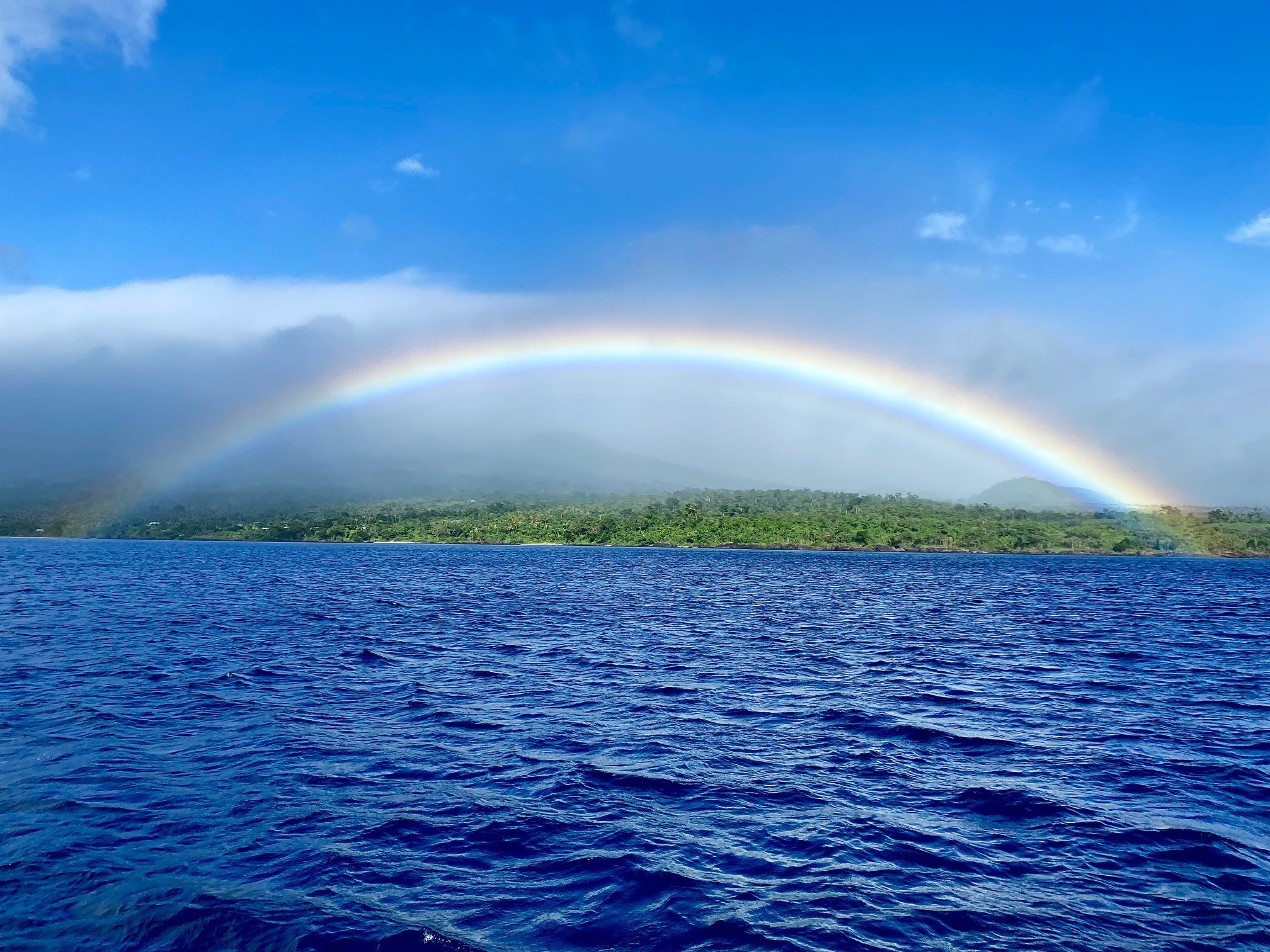
Rainbow over Guam
Rainbow over Guam

In Late February I flew back to Guam to do some much-needed work on my sailboat, and while here I definitely wanted to activate the 2 parks (K-0762 and K-0110) identified by the Parks On The Air team. The park activations in Washington and Texas were precursors to my 1-man holiday style DX / POTA activations.

The work on the boat took up more time than expected. Also, unusually strong trade winds made putting up the Buddipole antenna rather precarious and presented an almost constant risk of breaking or bending something. And to be completely honest, I did in fact break one extension arm and bend one of the extension shock-cord whips while setting up and a gust came from the opposite direction from the prevailing winds! Finally, although we are not yet in the rainy season, there were numerous rain showers that soaked various the island periodically throughout the day. The short story is that I didn't get on the air and play radio as much as I wanted, but I'm not finished yet and there will be more to come!

War In The Pacific National Historical Park 
(POTA K-0762)

Asan Beach Park

The War in the Pacific National Historical Park is actually 6 separate parks on the island of Guam. The largest of the 2 parks is Asan Beach in the village of Asan. This was the site of one of 2 main landing sites when the US Marines stormed Guam in 1944 to defeat the Japanese. However, very little remains of the fortifications and the area has been transformed into a popular beach park on the island. 

6 Units of War In the Pacific National Park in Guam

Working POTA/DX in Guam

On March 7, 2022, I activated the War in the Pacific National Historical Park (POTA K-0762). There are few picnic tables and no pavilions that would provide shade or protection from the weather. After spending a day to reconnoiter the vast park I finally decided on an area next to the parking lot at Asan Point to setup next to some bushes that would provide necessary shade. But the shade didn't appear until around 3 pm local time, and the park closed the gates at 6 pm. So, that gave me a 3-hour window to operate.

Asan Beach ops
I parked next to the grassy area where I setup my POTA shack. The POTA / 1-man holiday style DX shack that travels with me on my sailboat consists of a Helinox Table One Hard Top collapsible table, and a Helinox Chair One XL collapsible chair, a Honda EU2000i portable generator (very quiet), a Buddipole dipole on a Mastwerks 23' mast, a Powerwerx 30 amp switching power supply, an Elecraft KX3 transceiver, an Elecraft KXPA100 amplifier, and a Microsoft Surface Pro 2 tablet for running WSJTX for FT8 operations and ACLog for logging, and a Begali Adventure key for CW ops. The entire setup takes about 20 minutes. Tear down goes a little faster.

The first activation of this park was highly successful with 87 FT8 QSOs on 20M in about 3 hours of operation. Most of the QSOs were Japanese stations, but also include Indonesia, China, Brazil, Austria, Italy, Hawaii, Republic of Korea, North Macedonia, Texas, France, Spain, England, European Russia, Asiatic Russia, Australia, Denmark, and Canary Islands. I would say the propagation was great!

Based on my results from March 7, I returned to the same exact location in the park and setup on March 8. On day 2 of POTA operations at K-0110 I only made 74 FT8 QSOs on 20M. Hunters and DX'ers were from Republic of Korea, Japan, Texas, Hawaii, Uruguay, New Zealand, France, Asiatic Russia, China, England, Argentina, and Taiwan. Unfortunately, I had to stop transmitting and take 3 short breaks because the amplifier overheated. The average temperature in Guam is about 86F (30C) degrees. I only operated at about 50 watts and thought the almost constant winds would keep the amplifier cool. But for some reason on this day, I encountered an overheating problem. 

Ga'an Point Park


20cm Cannon
After a long break, on March 27 I activated the War in the Pacific National Historical Park at Ga'an Point in Agat village. 
This was the second primary landing beach for US Marines in 1944. This park is much smaller than Asan Beach but has the remains of a Japanese 20cm coastal defense gun, an anti-aircraft gun, a pillbox, and small caves where Japanese soldiers slept. There is no gate on this park, and it is open 24 hours a day. There are 2 picnic tables and a public restroom, but no pavilions for protection from the weather. As a big plus, it is a mere 3 minutes from the Agat Marina where I keep my boat.

Ga'an Point Ops
After finding a nice shady location to setup my portable "shack" and the antenna I started operations once again. This time along with the usual over-abundance of Japanese stations, I also had a total of 122 FT8 QSOs with Alaska, China, Republic of Korea, Texas, Washington, Hong Kong, Indianna, Canada, California, Indonesia, Oregon, Taiwan, Brazil, Asiatic Russia, Fiji, Australia, Hong Kong, Scotland, and the Republic of Korea.

All in all, with a little over 280 QSOs logged, March was not such a bad month.


Guam National Wildlife Refuge
(POTA K-0110)


Star Sand Beach
The second identified POTA park on the island of is the Guam National Wildlife Refuge. This is on the very north end of the island past Anderson Air Force Base which occupies much of the northern part of the island. The refuge is open Wednesday through Sunday from 07:30 am until 4:00 pm. Gates close at 4 pm! I drove up to the refuge and was introduced to the superintendent. Fortunately, she was familiar with amateur radio and showing her the POTA website helped explain my intent. She required that I submit a special use permit (something I wish I would have looked into earlier). Once submitted it only took about 1 week for approval. There were lots of restrictions; however, I was able to setup my POTA shack in 'disturbed' areas adjacent to parking areas. Not the most scenic area of the refuge, but I was able to operate inside the park boundaries!

Map of wildlife refuge on Guam
Finally, on the afternoon of April 2nd, I drove up to the refuge, setup the POTA shack and started FT8 operations on 20M and made 68 QSOs. Since I had to shut down at 3:45 PM I knew that I wasn't going to get as many European stations as I got at the War In The Pacific parks since most of those QSOs occurred after 4:00 pm local time. However, along with the Japanese stations I had contacts with New Caldonia, Republic of Korea, China, Asiatic Russia, Australia, Taiwan, Hawaii, Indonesia, and Washington. 

Moved ops for passing squall.
I decided to go back Sunday morning April 3rd and try again. I arrived at around 8 am, setup and started transmitting again. I wasn't getting pounced on by POTA hunters and DX'ers as in previous activations, to I switched to 15 meters and things started piling up. Unfortunately, around 11 am my amplifier stopped working. The KX3 was putting out a signal, but there was only a small trickle of power coming out of the amplifier. There were no over-heat indications. I tried shutting down and restarting. Taking a break to let it cool down. But nothing seemed to revive the amp. So, I shut things down and packed the kit back up. Fortunately, I was still able to make 50 QSOs, so the POTA activation still counted. 

AH2/WA7WJR POTA 405 QSOs

LESSONS LEARNED

  • When setting up a tripod hang a bag of sand or rocks from the bottom of the mast. This is an old photographer's trick to steady camera tripods. The additional weight is useful during assembly, while raising and lowering, and adds overall stability to the antenna rig.
  • Attach the guy lines to the mast, raise the mast, and secure the guy lines prior to attaching the antenna elements. This will prevent the mast from falling over with the antenna elements attached before the guy lines are secured. (Don't ask how I know this.)
  • If the park is a wildlife refuge, make sure you contact the park superintendent and inquire about special use permits well in advance of your planned operations. Also, check with staff as to operating locations within the refuge.
  • Find a shady spot to operate preferably with a good breeze. Don't forget water, sunscreen, and a good hat!
  • Carry spare Buddipole extension arms and whips, or an alternate antenna (e.g., wire antenna).
  • Pavilions are not always available. I'm going to look for a small 2-person tent to setup on days that have some probability of rain. 
  • When you go to a park to activate it for Parks on the Air talk to staff/rangers first to let them know what you're doing. Spend some time to identify operating locations that don't disturb the environment or other park visitors. And most importantly...spend some time enjoying the park and its beauty! Walk the trails, take a tour if available, and learn about the park's significance. 

Elecraft KX3 Macros for DXpeditions & POTA Using the QRPWorks SideKar

 I n my previous post  Elecraft KX3 Macros for Multi-Mode POTA Activations , I wrote about the recursive macros I programmed into the KX3 to...